Emmanuelle Castellan seeks to show the movement of struggle of the gaze: between desire for the present, woman’s reality and the arbitrary character of the sign. (L.U. friend’s thought)
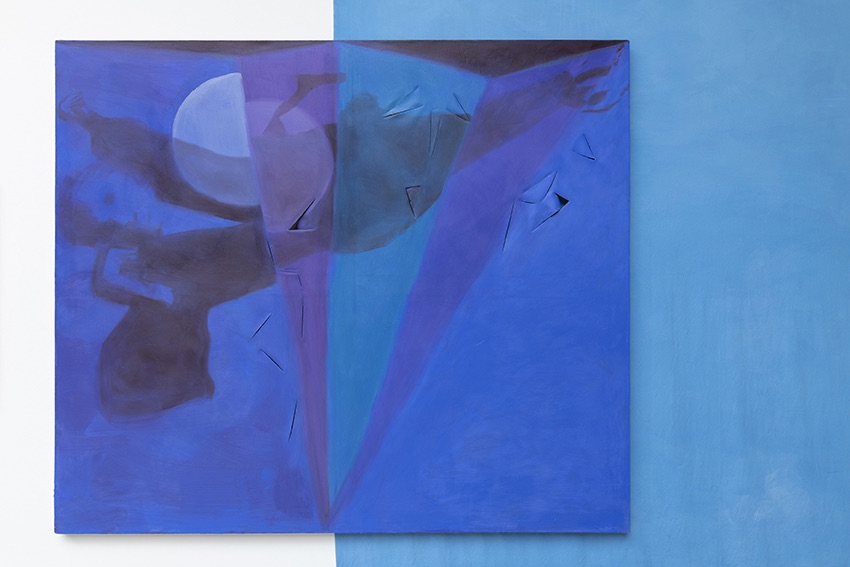
Le ravissement Castellan
Emmanuelle Castellan exhume des mondes dissimulés et c’est pour elle que je pense à Lol V. Stein : « ouvrir des tombeaux où Lol fait la morte »… L’héroïne du RavissementdeLolV.Stein, de Marguerite Duras, révèle le féminin-présent. La peinture de Castellan serait-elle en somme un remède à l’invisibilité féminine ? Le monde a beau être saturé de films d’action et d’idéologie patriarcale, il reste possible de voirmalgré tout et d’entrer dans le ravissement.
Pour ce faire, voici la peinture, ce medium qui passe pour suranné et dont la mutité dérange à l’heure actuelle. L’art contemporain veut tellement dire quelque chose, défendre une cause, « s’emparer », comme on dit, de ceci ou de cela pour faire passer un message. Et si c’était là un leurre stupide ? Et si cette obsession de s’accorder à tout crin avec les problématiques les plus affleurantes du monde contemporain était d’une affligeane naïveté ?
Voici la peinture, la « platte peinture » comme on disait jadis. Le paradoxe de la peinture de Castellan est de faire du profond avec du plat – et des aplats. Les multiples couches dont sont composées ses oeuvres ne sont pas seulement le fruit d’un travail matériel, encore que ce soit ansi que procède l’artiste : par approfondissement. La peinture s’enfonce très loin, dans les limbes d’un monde ambigü, sensuel, où frissonne la promesse encore suspendue d’émotions violentes et incontrolables. Tout est sur le fil : une main, une silhouette, comme un voile sur une corde à linge menacé de tempête. Cela se passe juste avant que tout se déchaîne, avant que le regard de l’admirateurice soit happé.
C’est aussi cela, le ravissement : certes, une extase à la fois religieuse et sexuelle comme la Sainte Thérèse du Bernin, mais aussi un rapt. Les spectateurices captivé·es sont kidnappé·es et plongent dans l’éblouissement, sans comprendre alors que plus rien ne sera pareil après. Lol V. Stein, lors du bal inaugural et fondateur du roman, voudrait que l’émotion qu’elle ressent en regardant son amant et une autre femme danser et tomber amoureux – que cette émotion, que cet instant ne s’arrêtent jamais. Elle voudrait fermer le bal et le rendre éternel. Elle voudrait que sans cesse se renouvelle l’instant extraordinaire qu’elle a vu et qui échappe normalement à toute vision. Elle a vu ce qu’on ne voit jamais. Elle est ravie, à tous les sens du terme.
C’est un sacré tour de force de représenter cela en peinture : cette imminence du rapt, cette possession instantanée, cet instant réputé invisible. La peinture est là(« elle dit : là » est une formule typiquement durassienne) pour qu’on voit ce qu’on ne voit jamais. On sait que les photographes animaliers usent des milliers d’heures à attendre un instant exceptionnel, mais c’est vain. On n’y arrive pas avec des photos. On n’obtient qu’une pétrification artificielle, comme le cri de Laocoon que détestait Lessing pour cette raison- même. Non, pour ravir, pour emporter le regard, pour permettre le rapt de l’âme sur des terres émotionnelles inviolées, il faut la peinture. Il faut cette peinture aux grands aplats mauves, aux violets mystiques, aux roses de fausse douceur où il se passe quelque chose de ténu, d’unique et d’atrocement réel. C’est cela-même la puissance de cette peinture.
Dans le monde de Castellan il existe des femmes alors que dans le monde bruyant des mecs elles sont ignorées, assassinées ou repoussées dans les marges. Dans le monde de Castellan il existe des espaces ouverts alors que nous n’en avons plus dans la vie réelle. Il existe des émotions authentiques alors qu’on nous avait habitué·es à l’ennuyeux téléguidage des scénarios répétitifs.
La peinture de Castellan c’est tout autre chose, c’est comme une réserve naturelle pour la véracité des émotions. C’est le paysage de l’âme véritable, exempte de tout processus préexistant. Muette par essence, la peinture se déploie dans tout sa splendeur. Ca lui va soudain terriblement bien, à la peinture, de ne rien dire, d’être silencieuse, de refuser d’accorder sa voix au concert cacophonique des hurlements ambiants.
Emmanuelle Castellan n’élève pas la voix. Elle donne à voir ce qui relève de la tension, de l’attente in-extremis, du point de bascule – du ravissement.
Texte de ïan Larue, autrice (grand prix de l’imaginaire catégorie essais en 2018), professeure d’université émérite et peintre, octobre 2024.
https://www.wallpaper.com/art/exhibitions-shows/emmanuelle-castellan-spektrum-la-verriere-brussels
https://www.lequotidiendelart.com/articles/25915-castellan-jeu-collectif.html
Elsa Meunier pour Between two times, dans les Yeux d’Elsa, Paris, 2024
There is great freedom in the way French painter Emmanuelle Castellan approaches painting.
Freedom, first and foremost, in her approach to the medium: loose canvases not stretched on
stretchers are hung on the wall, works on stretchers are superimposed on loose canvases, and
collages are made directly on canvases. These multiple proposals fully reflect the painter’s state of
mind with regard to her work. Each painting is unique and conceived in isolation. Each work is
fully autonomous and defined at the moment of creation, testifying to the infinite diversity of the
artist’s practice.
For Emmanuelle Castellan, the process is just as important as the result. From her initial idea,
Emmanuelle Castellan gives free rein to what emerges, letting herself be guided by what seems to
offer itself to her as she paints. Because even the artist’s surface is not approached in a linear way.
Emmanuelle Castellan frees herself from structural limits – she sometimes lacerates the canvas with
knife strokes or digs into the thickness of her successive applied layers – going beyond the flat
surface of the painting.
Like her approach to surface and available space, the artist’s compositions are free, loose and
juxtaposed. There is an equal dialogue between writing, figuration and large flat areas that leave
large free zones – breathing spaces. Shapes with flattened volumes emerge while others disappear,
leaving the imprint of their contours, spectres of their presence. Spontaneous in her gestures, the
painter seems guided by a strong intuition revealed in her brushstrokes. In just a few brushstrokes –
confident and precise – the form is there, the idea blossoms and the colours are fully articulated.
For this exhibition, the artist is presenting a series of paintings on stretchers dating from 2018 to
2024. The work Between Two Times, which could be likened to a more classical painting in its
composition, opens the way. A figure depicted from behind stands in the centre of the canvas,
between two picture windows. Through the colours and light that envelop and define them, these
two symmetrical spaces seem to suggest two spaces-time rather than the single space of this
domestic interior. This is an echo of her practice, marked by the time of the idea and the time of the
act of painting, sometimes overturning the guiding idea.
In this way, the work of painter Emmanuelle Castellan is as much in the tradition of the artists of the
Supports/Surfaces group, with her free relationship to the medium and the autonomy of forms
dictated solely by intuition, as than that of the current revival of figurative painting: female figures
punctuate her work, and everyday objects take centre stage (vase, glass, fan), over which space
always takes precedence.
Emmanuelle Castellan is a French painter who lives and works in Berlin. She is currently presenting
a solo exhibition at La Verrière – Fondation d’Entreprise Hermès in Brussels. Her work was recently
the subject of a solo exhibition at Galerie Valentin in Paris (2024). Last year, the artist presented a
solo exhibition in Basel at Ann Mazzotti gallery (2023).
Il y a une grande liberté dans la manière avec laquelle la peintre française Emmanuelle Castellan aborde la peinture. Liberté, tout d’abord, dans son appréhension du médium : des toiles libres non tendues sur châssis sont suspendues au mur, des œuvres sur châssis sont superposées à des toiles libres ou encore, des collages sont effectués directement sur toiles. Ces multiples propositions reflètent pleinement l’état d’esprit de la peintre vis à vis de son œuvre. Chaque peinture est unique et pensée de manière isolée. Chaque œuvre se révèle pleinement autonome et se définit au moment de l’acte de la création, témoignant de l’infinie diversité de la pratique de l’artiste.
Le faire est tout autant important que le résultat chez la peintre. De son idée première, Emmanuelle Castellan laisse libre cours à ce qui advient, se laisse guider par ce qui semble s’offrir à elle à mesure qu’elle peint. Car même la surface, chez l’artiste, n’est pas abordée de manière linéaire. Emmanuelle Castellan s’affranchit des limites structurelles – elle lacère parfois la toile de coups de couteau ou creuse l’épaisseur de ses couches successives appliquées – allant au-delà de la surface plane du tableau.
Tout comme sa manière d’aborder la surface et l’espace disponible, les compositions de l’artiste sont libres, relâchées et se juxtaposent. Dialoguent ainsi de manière égale : écriture, figuration et larges aplats laissant de grandes zones libres – des respirations. Des formes aux volumes aplanis émergent quand d’autres disparaissent laissant l’empreinte de leurs contours, spectres de leur présence. Spontanée dans le geste, la peintre semble guidée par une intuition forte que révèle sa touche. En quelques coups de pinceau – assurés et justes – la forme est là, l’idée s’épanouit et les couleurs s’articulent pleinement.
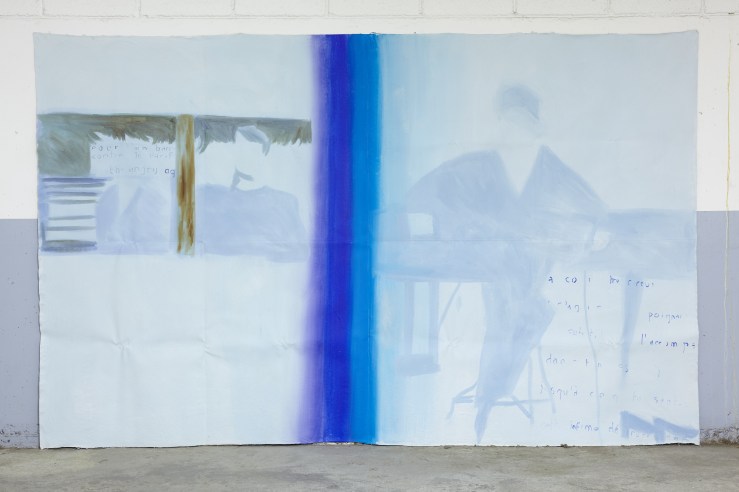
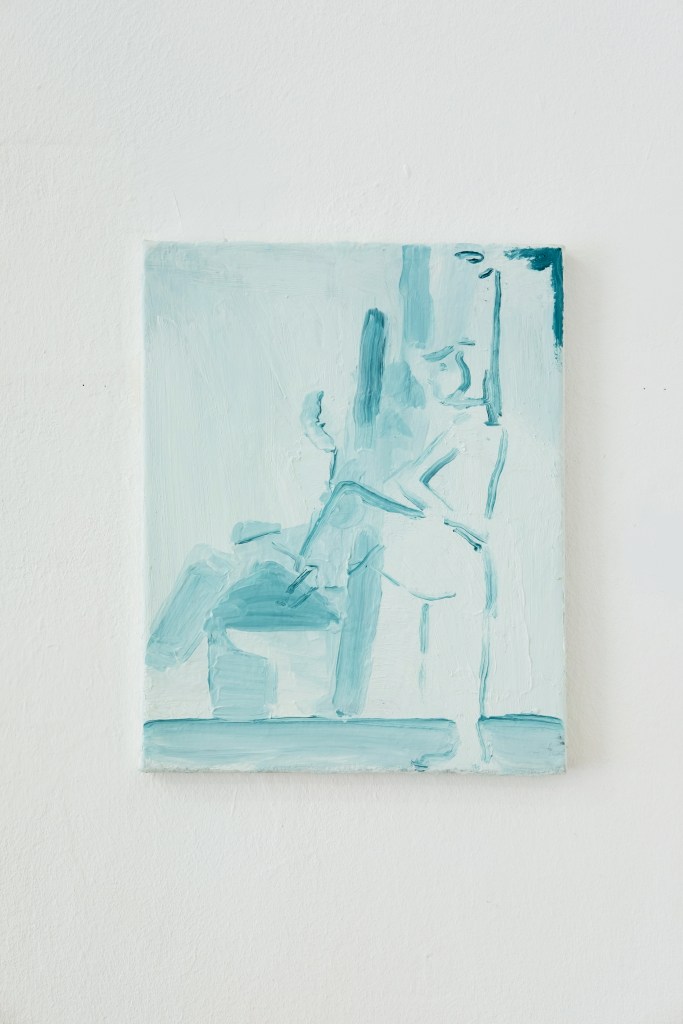
Pour cette exposition, l’artiste présente un ensemble de peintures sur châssis datant de 2018 à 2024. L’œuvre Between Two Times qui pourrait s’apparenter à une peinture plus classique dans sa composition, ouvre la voie. Un personnage représenté de dos se tient au centre de la toile, entre deux baies vitrées. Par les couleurs et la lumière qui les enveloppent et les définissent, ces deux espaces symétriques semblent suggérer deux espaces-temps et non plus celui unique de cet intérieur domestique. On peut y voir un écho à sa pratique, marquée par le temps de l’idée et celui de l’acte de peindre, bouleversant parfois l’idée directrice.
Ainsi, le travail de la peintre Emmanuelle Castellan se placerait autant dans la lignée des artistes du groupe Supports/Surfaces pour son rapport libre au médium et à l’autonomie des formes seulement dictées par son intuition, que celui du courant actuel du retour à la peinture figurative : des personnages féminins jalonnent son oeuvre, des objets du quotidien ont une place centrale (vase, verre, éventail), sur lesquels l’espace, toujours, prend le pas.
Emmanuelle Castellan est une peintre française qui vit et travaille à Berlin. Actuellement, l’artiste présente une exposition personnelle institutionnelle à la Verrière – Fondation d’Entreprise Hermès à Bruxelles. Son travail a fait récemment l’objet d’une exposition personnelle à la galerie Valentin à Paris (2024). L’an dernier, l’artiste a présenté une exposition personnelle à Bâle à la galerie Ann Mazzotti (2023).
Les oeuvres d’Emmanuelle Castellan ont été présentées dans de nombreuses expositions collectives en galerie comme chez Dilecta (2022) à Paris ou encore en institution comme au Museum Langmatt (2022).
Interview Frauke Boggasch and Emmanuelle Castellan, 2024
Text from Lucille Uhlrich for Behind the world order, Ann Mazzotti Gallery, 2023
Pandemie und wie weiter? — Emmanuelle Castellan
02.10.2020
von J. Emil Sennewald
Fortsetzung der Interview-Serie, die in der Juni-Ausgabe des Kunstbulletin begann und auf Distanz Nähe versuchte zum künstlerischen Prozess, zu persönlichen und professionellen Aussichten auf auf eine mögliche Zukunft. Gemeinsamer Nenner der Stellungnahmen war die Anerkennung eines grundlegenden Wandels im Kunstbetrieb – der auch fällig wäre. Während nach Lockerung der Ausgangsbeschränkungen, allfälligen Urlaubsreisen und der Wiederaufnahme des Betriebes in Frankreich ein zweiter Lockdown beginnt, zeigen sich die Konsequenzen gewünschter Verdrängung: die Realität bricht ein. Um sie zu gestalten, sind andere Aussichten nötig, die nicht auf ein Danach hoffen, das Jetzt fürchten, sondern mit dem Gegenwärtigen kreativ und engagiert umgehen. Da sie solche bietet, wird die Serie in loser Folge weiter hier veröffentlicht, um zum Nachdenken anzuregen darüber, was wird, mit der Kunst.
Fenster zur Welt?
Sennewald: Mit Deiner künstlerischen Arbeit als Malerin findest Du neue Wege, das Tafelbild als „Fenster zur Welt“ in Frage zu stellen, indem Du die Verwandtschaft mit dem Kino aufgreifst, sie mit Einschnitten in eine zauberhafte Dimension der Malerei verschiebst, die besonders in den letzten Arbeiten des Monats März zum Vorschein kommt. Die Betrachtenden geraten gleichzeitig hinter das Bild und mitten in die Malerei. Wie sieht für Dich, durch Deine Arbeit angeschaut, die Welt heute aus? Was wäre zu tun, was zu lassen?
Castellan: Den Lockdown habe ich zunächst als Chance erlebt: bei mir zuhause arbeiten können, ungestört. Aber rasch zeigte sich, dass ich sehr viel weniger Zeit hatte als gedacht. So war ich zum Beispiel stundenlang eingespannt vor dem Bildschirm, weil der Unterricht an der Kunsthochschule weiter ging. Auch hat sich im Alltag viel weniger geändert, als es schien. Das wiederum steht im Verhältnis mit meiner Malerei: sie folgt ihrer eigenen Zeitlichkeit. Auch wenn ich viel oder schnell malen will, bleibt diese eigene Zeit der Malerei bestimmend, egal, was sonst passiert. Es gab noch einen anderen Effekt: ich beobachte heute fast einen Zwang zur Kontrolle. Alles muss kontrolliert werden. Wenn ich male, geht es gerade darum, das nicht zu können. Loslassen-Können scheint mir jetzt ein sehr wichtiger Aspekt. Speziell angesichts einer Realität politischer Entscheidungen, die um jeden Preis auf Weitermachen setzen: das finde ich geradezu absurd, jetzt, da alle durch diese Pandemie verzweifelt, ermüdet sind. Hier braucht es nicht eine Autorität, die ein schlechtes Gewissen macht, zur Arbeit antreibt. Es braucht vielmehr eine neue Aufmerksamkeit, Sorge für die Menschen, Zuwendung, die ich allerdings vermisse. In meiner Malerei ging es mir zu Beginn viel um die paradoxale Eigenschaft des Gemäldes, zugleich in eine Bildrealität blicken zu lassen und mit diesem „Fenster“, das ein Bild-Schirm ist, die Wirklichkeit zu verdecken. Später kam ein Interesse für die Materialität der Malerei hinzu, speziell durch die Einschnitte in die Leinwand. Dabei geht es aber nicht so sehr um malerische Gesten, sondern um die Erfahrung einer realen Gewalt der Bilder. Mir geht es darum, diese Realität der Bilder durch Malerei zu dekonstruieren. Ich möchte das Bild auf eine Weise behandeln, dass man sich absorbiert fühlen kann von einer Präsenz und einer Intimität, die aus der Materialität der Malerei hervorgeht. Und das, ohne zu vergessen, dass der Fakt, etwas anzusehen oder einen bestimmten Blickpunkt vorzugeben inhärent von Gewalt durchlaufen wird. Das ist die Beziehung zum Körper, wie ich sie mit meiner Malerei bearbeite: er ist als abwesender präsent in einer Malerei, die mit und aus Gewalt entsteht.
Berlin, 15. Juni 2020
Link: https://emmanuellecastellan.net/
Die Arbeit von Emmanuelle Castellan ist im Rahmen der Gruppenausstellung „Staying with the trouble in painting“, veranstaltet vom Espace Mourlot im Building Canebière in Marseille, noch bis 5.11. zu sehen. https://p-a-c.fr/les-membres/espace-mourlot/staying-with-the-trouble-in-painting-building-canebiere
J. Emil Sennewald, Kritiker und Journalist, unterrichtet an der Kunsthochschule ésacm in Clermont-Ferrand und der F+F Schule in Zürich, berichtet seit über 15 Jahren über Kunst aus Frankreich. emil@weiswald.com, www.weiswald.com
Lucile Bouvard, Bar Babette, Berlin, 2018
Emmanuelle Castellan’s pictorial practice extends from a classical form of painting to three dimensional flat pictorial sculptures, and site-specific wall-painting environments. The artist finds her inspiration in a wide range of images found in postcards, magazines, old photographs, illustrations from the Internet — mainly rooted in popular culture — taken as such or recomposed. The artists repeat the image several times, before systematically effacing it and starting over. What remains from this process are residual elements, marks that eventually becomes the really subject of the painting. Often repeated or emerging through the gradient of pastel colors of the painting’s surface like “surviving images”, they set the clues of elusive narratives and ghost stories.
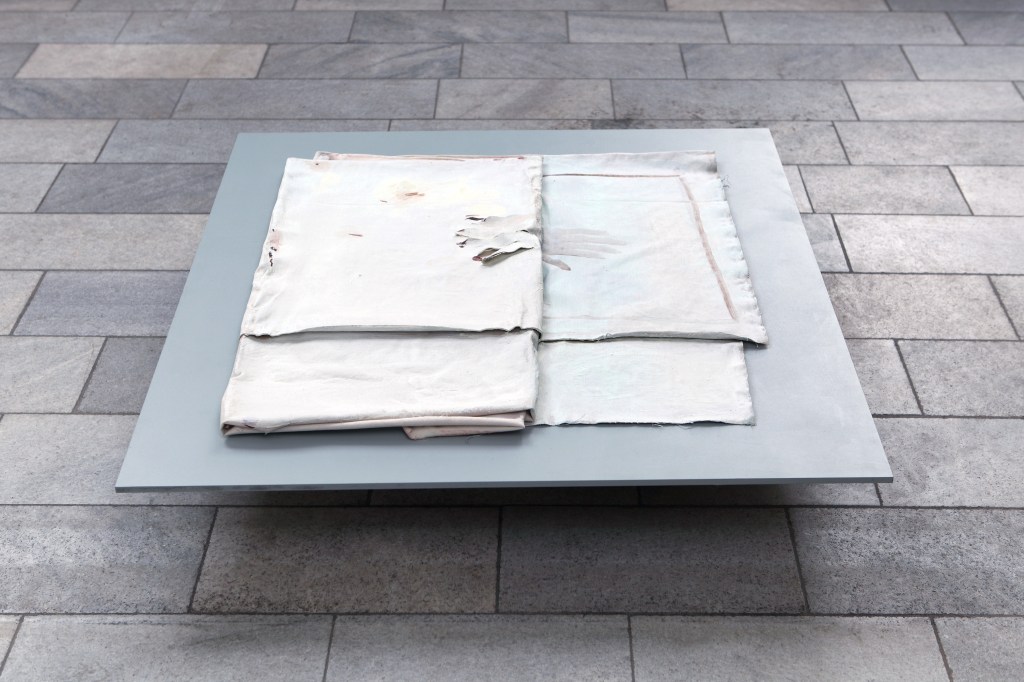
Shown for the first time at Bar Babette, Double hands is the results of various experiences, folding and painting applied by the artist. Two hands emerge from the fold in a mirroring effect: one painted, and seemingly human, just appears onto the surface of the canvas, the other both painted and cut seems coming out and is endowed with animal features. Its claws-like nails transfer the latter into a hybrid anthropomorphic and bestial being and conjure up a mysterious and powerful presence. Stemming from various inspiration sources, it calls to mind iconic works by Meret Oppenheim or designer Elsa Schiaparelli, two « women-witches » as the artists call them, these female artists have open a path which allows her to explore freely “ethereal places from the realm of the touch, sometimes somehow dark or very soft”. (her tactile experience of painting making with softness or a hint darkness.
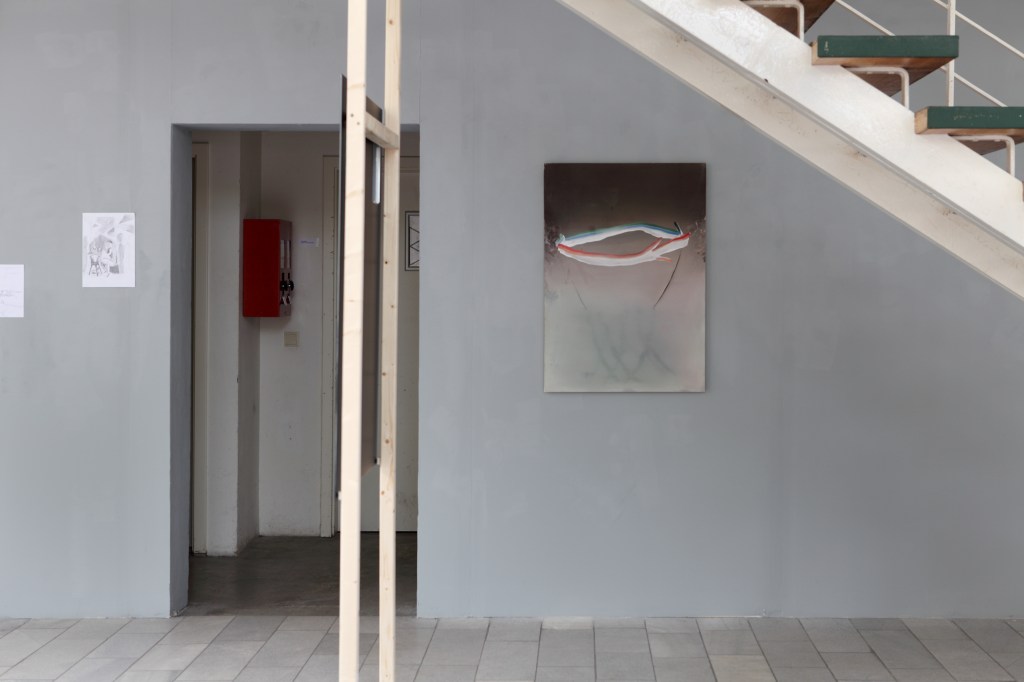
The painting elastic boards was primarily inspired by a vase of architect and designer Josef Hoffman. The features of the vase have almost disappeared and are merely outlined by two curve cuts. Its decoration has muted into a large colored opening in the shape of a mouth or the outlines of an eye. The paintings is marked on its size by the artist’s fingerprints. She left it in the fresh paint, when trying once to manipulate it like an antic mask. This anecdote is quite revealing of the artist tactile and sensual relation to her medium and of the open-up nature of picturial practice.
Simone Zaug, Kurt Kurt, Berlin, 2018
Bei Emmanuelle Castellan wird die Malerei zu einem sich ständig verändernden, instabilen Prozess, der auch Zeit als Dimension mit einbindet. Die Materialität ihrer Malerei und die Entgrenzung ihrer Bilder führen dazu, dass Raum als Ort der Verwandlungen, des Widerspruchs, der Entzifferungen betrachtet werden kann. Innerhalb und außerhalb des Rahmens ihrer Bilder interessiert Emmanuelle Castellan besonders der Körper, der oft einer Identifikation entgleitet oder sogar entflieht.
Ihre Kunst stellt nicht nur Fragen an die Malerei, sondern auch nach Raum, Zeit und Bewegung. Nicht das Sichtbarmachen steht im Vordergrund, vielmehr beschäftigt sich die Künstlerin mit dem Verstecken, Verhüllen oder nur vagen Vorschlagen von Bildern bis zu dem Punkt, an dem die Bilder zwischen Zeichen und Gesten unlesbar werden. So verbindet Emmanuelle Castellan in ihren Bildern unvorhersehbare und widersprüchliche Aspekte mit fragilen und prekären Existenzformen.
In ihren jüngsten Forschungen verbindet sie die Anfänge der Moderne, z.B. Verweise auf Objekte und Skizzen von Josef Hoffman oder den Tanz von Pina Bausch und Mary Wigman, mit der Darstellung des Körpers in flüchtig digitalen Werbespots im heutigen Internet.
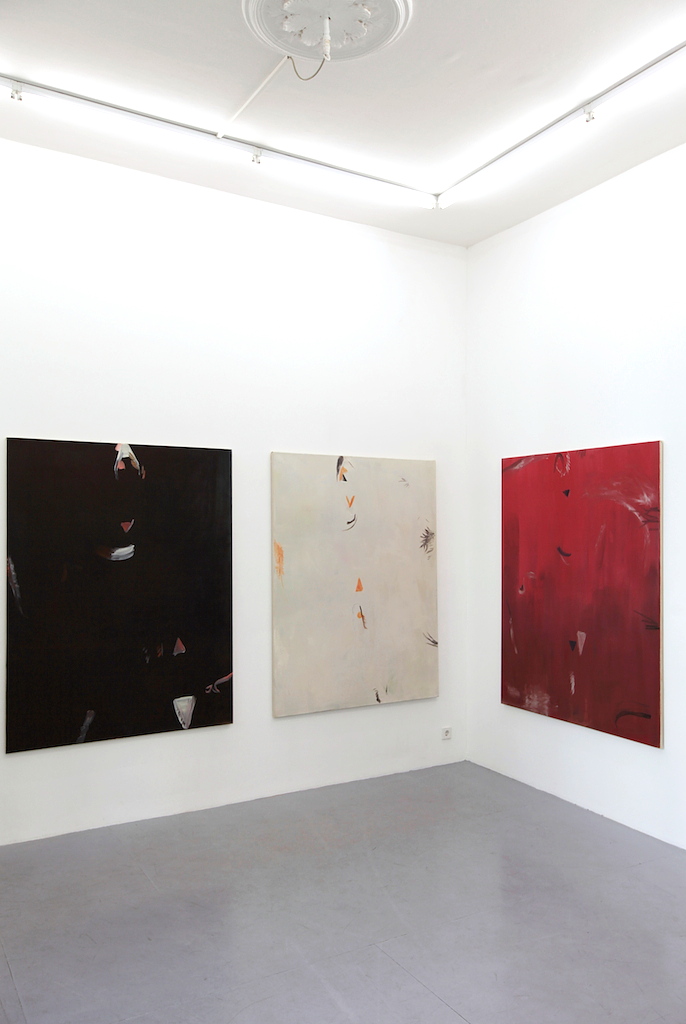
Für die Ausstellung im Kurt-Kurt inszeniert die Künstlerin eine mehrteilige Reise, die uns von der Malerei über den Raum zum Körper führt.
 Article from Fleur Helluin, 2014
 Emmanuelle Castellan
You must be logged in to post a comment.